New Life, New Creation

New Life, New Creation

Throughout my life and ministry, I can remember several unique and memorable Easter celebrations. I remember the first time I served as a lay reader on Easter Sunday. Not only was I to read the lectionary passages for the day, but I was also asked to help serve communion, So, there I was with the assistant pastor, a friend of mine, when someone tried to take the cup and drink out of it. I lost it. It wasn’t how we did things around there, though in other traditions that would have been acceptable.

There have been times, too, as a pastor that have been joyous. My first Easter Sunrise as a pastor I remember smelling the food coming out of the kitchen and getting hungrier and hungrier as I spoke. There was the time at Claylick that people thought I had forgotten the service when I wasn’t there at my usual 30 minutes before the service. And there was a couple years ago at my last appointment when we were planning a 200th anniversary a few weeks after Easter and wondering if we had the strength to do both well.

What I remember, as well, are the moments of tension of wanting everything to glorify God, and, as well, to make people happy. Much of our Easter services are a pageantry of the holy name of God. A show on our biggest day of the year, because we believe the grandeur of the importance of an empty tomb requires all the bells and whistles. Too often, I get lost in those elements, making sure everything is right, to the point that when I get home on Easter Sunday I am not filled with hope, but overwhelmed with exhaustion.

We approach, then, what will certainly be a memorable Easter celebration in our lifetimes. Not since the Spanish Flu pandemic in 1918 have churches closed their doors in order to provide safety for their people and others during a health crisis. We will continue to be closed until such time that it is safe to be back together. This is a unique time, and perhaps we are wondering if we can really celebrate Easter without the bells and whistles and, truly, without being in the church.

Perhaps, just maybe, the lack of the bells and whistles, the full regalia of the day, will allow us the possibility to hear the story of Christ’s resurrection in a new way. A way that will relaunch us into being Easter people, filled with the hope of the resurrection, and confident in knowing that Christ is alive even in times like today. Perhaps, just maybe, we can give our full attention not to the grandeur, but to the simplicity of the message and the mission that is before. Continue reading “New Life, New Creation”

One Week of Grief and Lament

One Week of Grief and Lament

As we begin our time of reflection upon the Gospel, this morning, I am mindful of the fact that our Lenten sermon series is a little disjointed. We took a week off, last week, to reflect on how we can be the people of God in the midst of these difficult times. At the same time, I recognize that, because of the nature of how we are worshiping today, that many of you are coming into a sermon series that is a few weeks old. With that in mind, I want to take a moment and get everyone caught up on where we are.

Our series, called One Week, is focused on the events of Holy Week. It is the week where we commemorate the Jesus’ activities in Jerusalem that lead up to his betrayal, death, and resurrection. What we describe as Holy Week took place during the Jewish festival of the Passover, which remembers God’s redemption of Israel from Egyptian slavery. In this series, we have wanted to tell the stories of the events during that fateful Passover that do not receive the attention of sermons, Bible studies, and conversations.

There have been some key moments in the series. We began three weeks ago, which seems like a year ago in a different time and place, by looking at how Jesus expressed holy frustration in the Temple for it becoming consumed with things not of God. From there, we looked at how Jesus cursed the fig tree in a call for those who would follow him to seek to live out our faith in Christ. Last week, had we not focused on the realities of our current world, we would have seen how Jesus called out the hypocrisy of the religious elites for saying one thing and doing another. Tensions are picking up, especially now as Jesus expresses his grief and lament at what he sees in Jerusalem and the people of faith. Continue reading “One Week of Grief and Lament”

One Week of Upsetting the Norms

One Week of Upsetting the Norms

The events of Jesus’ passion are the most significant moments in not just the history of our faith, but all of human history. We position these events, traditionally, in a week-long celebration known as “Holy Week” or “Passion Week.” No matter how the week is named, the purpose is the same and that is to celebrate and commemorate the moments that lead up to Jesus’ arrest, death, and resurrection.

When we come to Holy Week, however, we mostly focus on just a few moments within that week, especially towards its end. We focus on Jesus procession into Jerusalem on Palm Sunday. We dine with Jesus and the disciples in the Upper Room and pray with them at the Garden of Gethsemane on Maundy Thursday. We mourn at the foot of the cross on Good Friday. Those are, traditionally, the moments we focus on, yet there is vastness of experiences throughout the week that we rarely talk about.

Among those moments we rarely talk about, how can they lead us to a deeper faith? What within those moments that don’t get the attention can help us to understand how Jesus went from a heralded king on Sunday to being treated as a traitor and blasphemer by Thursday? Those two questions, and others, are what we are going to use to center ourselves throughout Lent. We will examine these events that transpire early in Holy Week and contemplate upon how they advance the narrative of the conflict between Jesus and the religious elites. As well, we will see how they enable us to experience what Jesus was doing in the world and our lives today.

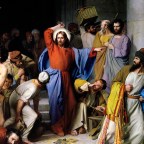
Our journey with Jesus through Holy Week begins with one of the most intense moments in the Gospels. It was a moment initiated by Jesus in response to something he saw when he entered the Temple. Yes, we are talking about the time Jesus flipped the tables and cleaned house in the Temple. It is one of the places that challenges our idea that Jesus was always mild-mannered. (That is what we desire of Jesus, by the way.) What took place and why should it matter to us today? Continue reading “One Week of Upsetting the Norms”

Why So Angry?

Why So Angry?

Have you been paying attention? There has been a common theme, these last few weeks, of raising the stakes and expectations upon what it means to be a follower of Christ. It began as we joined the disciples and crowds who gathered along the shores of Galilee to hear these teaching statements when they were first delivered. We gather, today, to reflect upon what it means to live for Christ.

Throughout this study of Matthew 5, we’ve talked about some difficult and challenging passages and how they apply to our lives. If you remember, we said Jesus gathered this group together to express what the kingdom of God was all about. This was after people were curious about Jesus after he began preaching and healing throughout Capernaum and Galilee. As the crowds gathered around him, Jesus wasn’t interested in creating a popular movement that gave people what they wanted to hear. He wasn’t there to please the people.

He came to raise the expectations by expressing what it means to follow God and live out our faith. Jesus does not desire disciples who merely just show up or claim a faith in God but never put it into practice. He is interested in disciples – followers of Christ – who seek to become less of their own self and more like Christ every day. Continue reading “Why So Angry?”