
Some Questions to Think About
Perhaps it is the old journalist in me, but I appreciate a good question. A good question can lead to … Continue reading Some Questions to Think About
Perhaps it is the old journalist in me, but I appreciate a good question. A good question can lead to … Continue reading Some Questions to Think About
I’ve been reading, this week, looking ahead to 2018 and contemplating where I believe God is leading us at Ogden Memorial. One of the books I am reading is Richard Foster’s classic Celebration of Discipline.
This was a book I had to read in seminary, which meant it was one of those you rushed to finish in order to move to the next assignment. I’ve always appreciated what I read from the book, but nothing really struck me as deeply profound because I was reading it with a different purpose of simply completing an assignment.
That is until I read the book’s first paragraph this week. It says:
Superficiality is the cure of our age. The doctrine of instant satisfaction is a primary spiritual problem. The desperate need today is not for a greater number of intelligent people, or gifted people, but for deep people.
Foster wrote those words in the 1970s. They are still appropriate for us today. We are in hurry in a life and, as a result, we never experience the fullness of God’s desires for us. Continue reading “Better Than a Drive-Thru”
We all have a definition of the church. Some of us may see the church as the building where we gather for weekly worship and Christian discipleship. Others may see the church as an institution that primarily exists for Christians who seek to be in relationship with other Christians. Perhaps some others may see the church as a community that is not important for spiritual growth and discipleship.
How do you see the church? How do I see the church?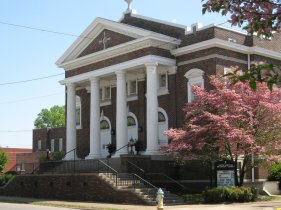
My definition of the church is it is the “ongoing witness of Jesus Christ in a broken and hurting world.” The church, for me, is not a noun. It is a living and breathing movement of God. Continue reading “What is the Church Here For?”
For three years, I worked in public policy and gained first-hand experience to the growing polarization that exists in our nation. I went into it, perhaps, with a bit of naive hopefulness believing that everyone would work for the same common principles, especially since we were an issue-oriented group. What I often saw was how some were more interested in defeating the “other side” than about promoting the cause or working towards a consensus.
That experience led me to make one of the most common statements I share about my time before going into ministry: I give thanks to God I had some political experience, because it has helped to find my way through church issues.
It is sad for me to admit that being in politics, even as a staff writer for a higher education policy group, was one of the best training grounds for ministry, because it gave me on-the-field perspective regarding the polarization that exists in the church today. The church, especially my own United Methodist Church, is suffering in the United States because we often reflect of the same political polarization that has crippled Washington, D.C., and state houses across the nation for a generation. We are more interested in winning political arguments than we are about “making disciples of Jesus Christ for the transformation of the world.” Continue reading “Enough With Church Politics”
In anticipation of Presidents’ Day, C-SPAN released its updated list of the greatest presidents. The list was based on a survey completed by historians, professors, and media professionals. It is an interesting list, and like all surveys is subjective based upon the viewpoints of the individual’s ranking bias (conservative/liberal, strong government/weak government, etc.).
The list made me think of my own list that I put together five years ago and the need for it to be updated to reflect the end of the Obama Administration. That list, and the one that will follow, was my own reflection based on my studies of the presidents.
It is fair to list my biases at the start of the listing. I favor the long-term influence of a president over historical popularity. I also look at leadership competencies in the realm of whether the individual was able to motivate the nation to a purpose, was driven, and took control of the issues. Lastly, I want to look at whether the individual was effective in dealing with those issues that faced them.
I also believe it is worth noting that modern presidents are hard to rank. That is because the emotions (both positive and negative) drive a lot of our views on the effectiveness of a particular president. I have argued that it takes a generation to truly get a good perspective on an administration. I am beginning to wonder with the advent of social media that it may take multiple generations to evaluate presidents in this Technology Age.
That being said, here is my list of the greatest presidents … 2017 edition: Continue reading “Who is the Greatest President? (2017 Edition)”
 Shannon Blosser